Portfolio

Teaching Portfolio · Chapter 7

Evidence of Impact

This chapter shows how I use student responses, formative assessment, peer review and observation feedback to understand the impact of my teaching on students' Computer Science reasoning.

Chapter purpose

Showing how teaching supports student learning

For me, evidence of impact is not limited to grades or test results. It can also be seen in the quality of students' explanations, their use of accurate subject vocabulary, their ability to apply concepts independently, their participation in discussion and the way they respond to feedback during a lesson.

In this chapter, I focus on evidence from an AP Computer Science Principles FRQ deconstruction lesson. Students were preparing to answer exam-style questions using their own Personalized Project Reference, so the impact I was looking for was not only whether they could write an answer, but whether they could explain program behaviour precisely and link their response to their own code.
Impact cycle

Planning, teaching, checking and responding

The evidence in this chapter shows impact as part of a learning cycle. I first planned a sequence that helped students compare weak and strong answers, interpret code in context, deconstruct FRQ wording, peer-review anonymised answers and finally apply the strategy to their own Personalized Project Reference.

The student responses then helped me evaluate the impact of the lesson. Some students could name the relevant list in their own project and explain how program behaviour would change if it were empty. Others still needed support to make cause-and-effect explanations more precise. This evidence helped me decide what to reteach and what sentence frames would support future answers.

Evidence 7.1

Exit Ticket: Applying FRQ Thinking to Students' Own Projects

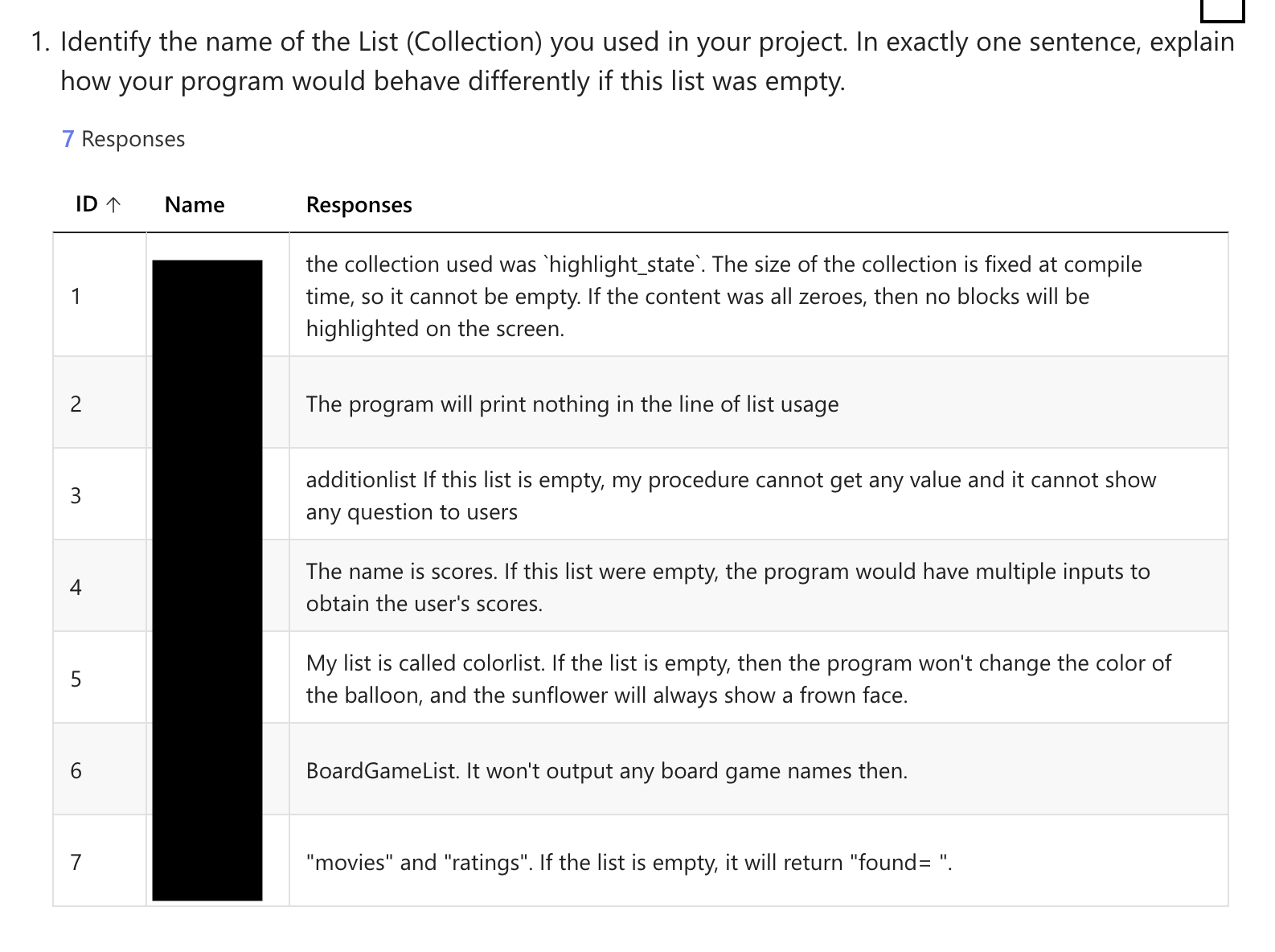
An anonymised exit-ticket summary showing students naming a list in their project and explaining how the program would behave if the list were empty.

Evidence extract

This exit ticket asked students to identify the name of a list used in their own project and explain, in exactly one sentence, how the program would behave differently if the list were empty.

The evidence shows students linking FRQ concepts to their own code, using examples such as highlight_state, colorlist, BoardGameList, movies and ratings. Stronger responses explained specific program behaviour, such as no blocks being highlighted or no board game names being output.

This is evidence of impact because students were beginning to move beyond generic exam answers towards project-specific reasoning. It also revealed a next step: some responses still needed clearer cause-and-effect explanation using sentence frames such as "If the list were empty, then..." and "This would affect the program because...".

View evidence image

Exit-ticket responses

The original anonymised exit-ticket screenshot is shown below. It can also be opened in a new tab for closer viewing.

Anonymised exit-ticket responses about lists and program behaviour
Exit ticket Individual understanding Lists Program behaviour Cause and effect Responsive next steps

Evidence 7.2

Independent FRQ Task: Applying the Deconstruction Strategy

Student responses showing how reflection prompts supported students to develop final exam-style answers.

Evidence extract

This evidence shows students breaking an FRQ question into smaller thinking steps before writing a final response. Students first described the output or effect of a procedure call, then considered whether a different argument could produce the same outcome.

The task helped students move from planning to a final answer. Some responses clearly described the outcome of a procedure call and explained why changing arguments would or would not produce the same effect.

This is strong evidence of impact because students were not simply copying a model answer. They were applying a strategy to their own Personalized Project Reference and beginning to understand that full-mark FRQ answers require precision, explanation and a direct link to the project.

View evidence document

Independent FRQ task

The original student-response evidence is shown below in a compact preview. The reader can scroll inside the PDF or open it in a new tab.

Independent application FRQ deconstruction Project-specific reasoning Exam language Precision

Evidence 7.3

Peer Review Activity: Understanding What Earns Marks

Anonymised peer-review work showing students judging FRQ responses against success criteria.

Evidence extract

In this activity, students reviewed anonymised FRQ answers and decided whether each response earned the mark. They had to identify the mark point, explain why the answer did or did not earn credit, and write what needed to be improved.

This developed students' assessment literacy. They were learning that a correct idea is not always enough: an answer often needs to explain how or why, use accurate terminology, and connect directly to the procedure, list or Personalized Project Reference.

The evidence also helped me refine the task for future teaching. Anonymised peer review reduced pressure, but I would add an even clearer checklist so students can judge precision, vocabulary and project link more consistently.

View evidence document

Peer review activity

The original peer-review evidence is shown below in a compact preview. The reader can scroll inside the PDF or open it in a new tab.

Peer review Assessment literacy Success criteria Feedback Exam preparation Precise explanation

Evidence 7.4

Observation Feedback: Impact on Participation and Independent Application

External observation feedback confirming student participation, FRQ deconstruction and independent application.

Evidence extract

This observation provides external evidence that students were engaged during the FRQ deconstruction lesson. The feedback notes that students paid attention to the problem presented, participated eagerly in code interpretation, practised how to deconstruct FRQs and applied their learning using their own PPR.

This is useful evidence of impact because it confirms that the lesson moved through a clear process: understanding the question, interpreting code, practising the deconstruction strategy, and applying it independently.

The feedback reinforced the value of modelling exam thinking explicitly. It showed that exam preparation can be structured as active reasoning rather than passive revision.

View evidence document

AP CSP observation feedback

The original observation feedback is shown below in a compact preview. The reader can scroll inside the PDF or open it in a new tab.

Observation feedback Student participation Code interpretation Questioning Independent application Appropriate challenge

Evidence 7.5

Lesson Plan: Planning for Impact in FRQ Responses

The lesson plan showing how student impact was planned through modelling, peer review, deconstruction and independent application.

Evidence extract

This lesson was designed to help students identify what earns marks in FRQ answers, deconstruct questions before answering, and write structured responses linked to their own Personalized Project Reference.

The planned sequence moved from comparing weak and strong answers, to interpreting code in context, modelling a deconstruction strategy, peer-reviewing anonymised answers, discussing mark-worthy responses and applying the strategy independently.

This evidence supports the chapter because it connects teaching decisions to visible impact. The exit ticket, peer review and independent task were deliberately planned to make student understanding visible and to improve the precision of students' written explanations.

View evidence document

FRQ deconstruction lesson plan

The original lesson plan is shown below in a compact preview. The reader can scroll inside the PDF or open it in a new tab.

Planning for impact Model answers FRQ deconstruction Peer review Formative assessment Exam readiness